CardioGuard
AI-powered cardiovascular disease risk assessment
Built for Byte 2 Beat Hackathon by Hack4Health
AI-Powered CVD Risk Assessment
CardioGuard is an AI-powered cardiovascular disease (CVD) risk assessment tool developed for the Byte 2 Beat Hackathon. This project demonstrates the application of machine learning in healthcare to enable early detection and risk stratification of cardiovascular disease.
Our model analyzes patient demographics, vital signs, laboratory values, and lifestyle factors to predict CVD risk, helping to identify individuals who may benefit from preventive interventions.
Data Collection
Patient information is collected including age, gender, height, weight, blood pressure, cholesterol, glucose levels, and lifestyle factors.
Machine Learning Analysis
Our trained model processes the input data using patterns learned from thousands of patient records to assess cardiovascular disease risk.
Risk Prediction
The model outputs a risk classification (High/Low) along with a probability score, providing clear, actionable insights.
Interpretability
Results are presented with explanations to help understand which factors contribute most to the risk assessment.
Early Detection
Identify high-risk individuals early for timely intervention and prevention strategies.
Evidence-Based
Model trained on real biomedical data with established CVD risk factors.
Scalable Solution
Web-based platform enables widespread access to CVD risk assessment tools.
Interpretable AI
Clear explanations of predictions support clinical decision-making and trust.
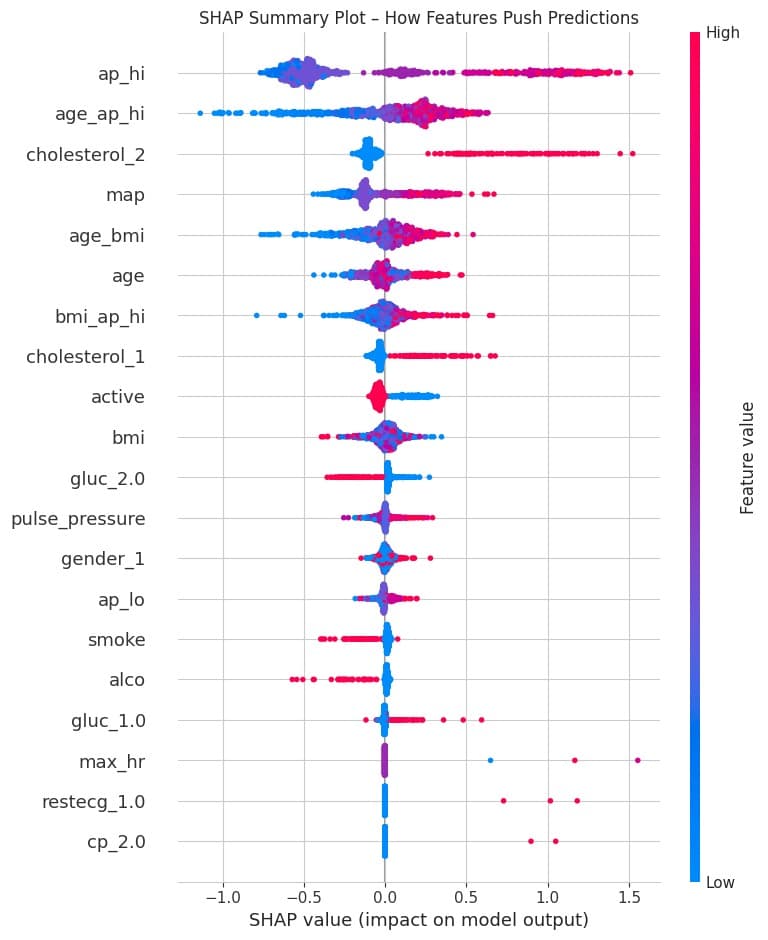
Our model uses SHAP (SHapley Additive exPlanations) to provide transparent, interpretable predictions. Below are visualizations showing which features have the most impact on CVD risk predictions.
Feature Impact Summary
Shows how each feature pushes predictions toward high (red) or low risk (blue).
Top Risk Factors
Ranking of features by average impact. Systolic BP (ap_hi) and age are strongest predictors.
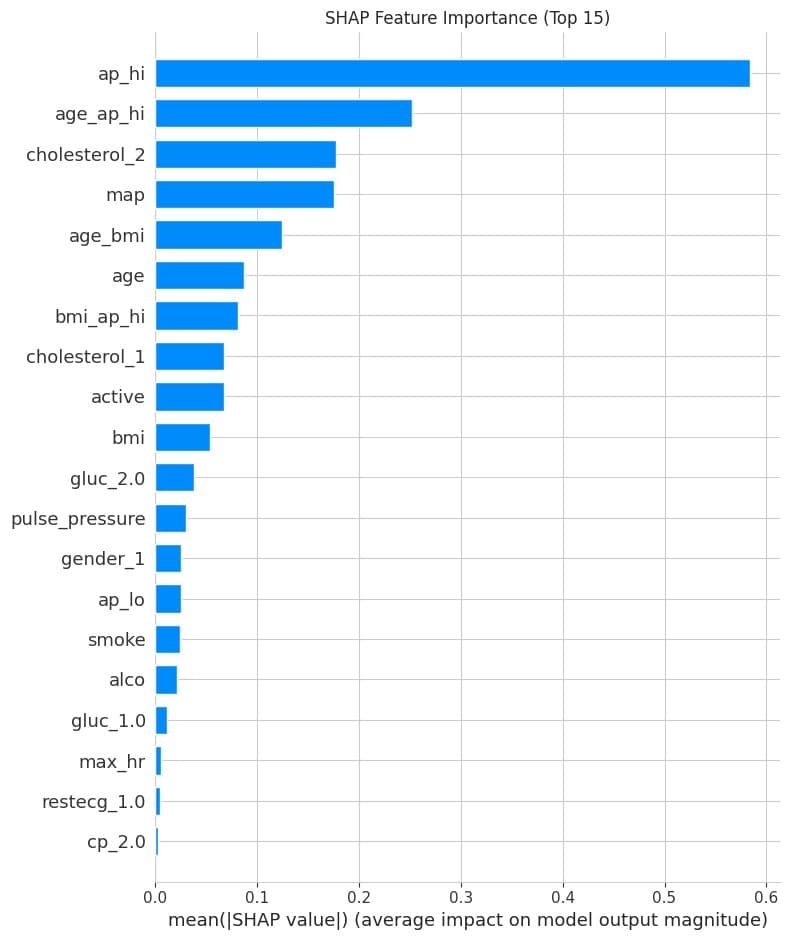
Key Insights: The model identifies systolic blood pressure, age-related features, and cholesterol levels as the most significant risk factors, aligning with established medical research on cardiovascular disease.
Important Notice
This tool is designed for educational and research purposes only as part of the Byte 2 Beat Hackathon. It is not intended for clinical use and should not replace professional medical advice, diagnosis, or treatment. Always consult qualified healthcare providers for medical concerns.